So, lets talk about a subject that can be quite sensitive, and often for the wrong reasons – periods.
In this day and age we can all wish that this wasn’t something that people kept hidden, as if it were something shameful, but for whatever reason, lots of us still do. But not today.
According to the London Assembly approximately 4.3 billion menstrual products are used per year in the United Kingdom which leads to a calculated 200,000 tonnes of menstrual waste products being discarded every year. To put that into perspective on an individual level, it is believed that each menstruating individual will use between 11,000 to 16,000 period products (either pads or tampons) in their lifetime which results in approximately 200kgs of period items thrown away during the span of a life. And we all know that these products end up in one of two places – in the landfill or down the drain. Neither of these end points is ideal. When we then consider these figures multiplied by the number of menstruating individuals across the globe that have access to and regularly use standard period items – well, that’s a lot of biologically contaminated plastic-based products that won’t be going anywhere anytime soon.
If this is the first time seeing these figures, it might be a bit of a shock to realise that, on an individual level, we are contributing so significantly to a rising plastic waste issue. I mean, I certainly hope I wasn’t the only one who couldn’t see (or wasn’t willing to see) how serious this problem was. Please don’t feel that you are alone in feeling upset and a bit fearful when coming to this realisation – its honest scary to think about on a wide scale.
Before we start the conversation about reusable products that are out there, I feel we need to talk about advertising for period products. For many people who develop a period, or experience a regular bleed, some kind of product to protect your clothing and collect the blood is a necessity. We’ll have no talk of these being luxury items here. But beyond that controversial sub-topic, the market that exists for period products is made up of items that are, conventionally, made up of 90% plastic. During my formative years, when I was learning about how to manage my own period the adverts on television showed only disposable products from companies like ‘Always’ and ‘Bodyform’ and this advice was often echoed by my family, so I used these brands as they were on the shelves in the supermarkets and easy to access.
Before 2022 and the Code Red warning for earth, there weren’t many adverts encouraging individuals that menstruate to seek out non-disposable options. I can think of a few and they definitely weren’t common on the television – I sometimes see adverts for period underwear, menstrual cups or ‘moon cups’, but only in more recent years, and these products still aren’t regularly available on the supermarket shelves, despite the push for reducing plastic waste. So, I had to start with doing my own research.
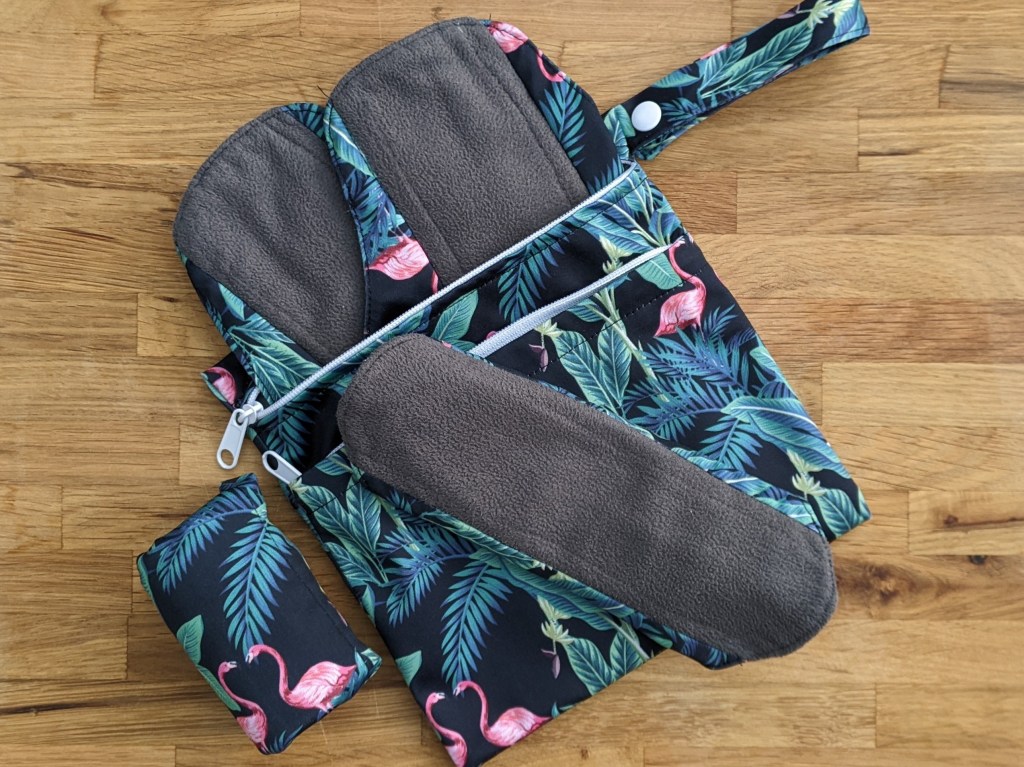
The first choice I had to make was how much I was willing to spend. I really wasn’t sure how I felt about reusable period products overall, so I didn’t want to splash out on an expensive brand when the change might not stick. I found a company called eco bravo where I could get a set of reusable period products for around £20. I thought it was reasonable and went for it. These pads have a fleece lined centre, with flamingo pattered wings that had poppers to help keep them secured in your underwear. As someone with sensitive skin, these were such a significant change from the uncomfortable plastic liners I had been using before. They felt secure and stayed put throughout the day. They were my go for the next 12 months or so and after some adjustment, I was content with them. The only problem was that there wasn’t really enough for me to get through my period.
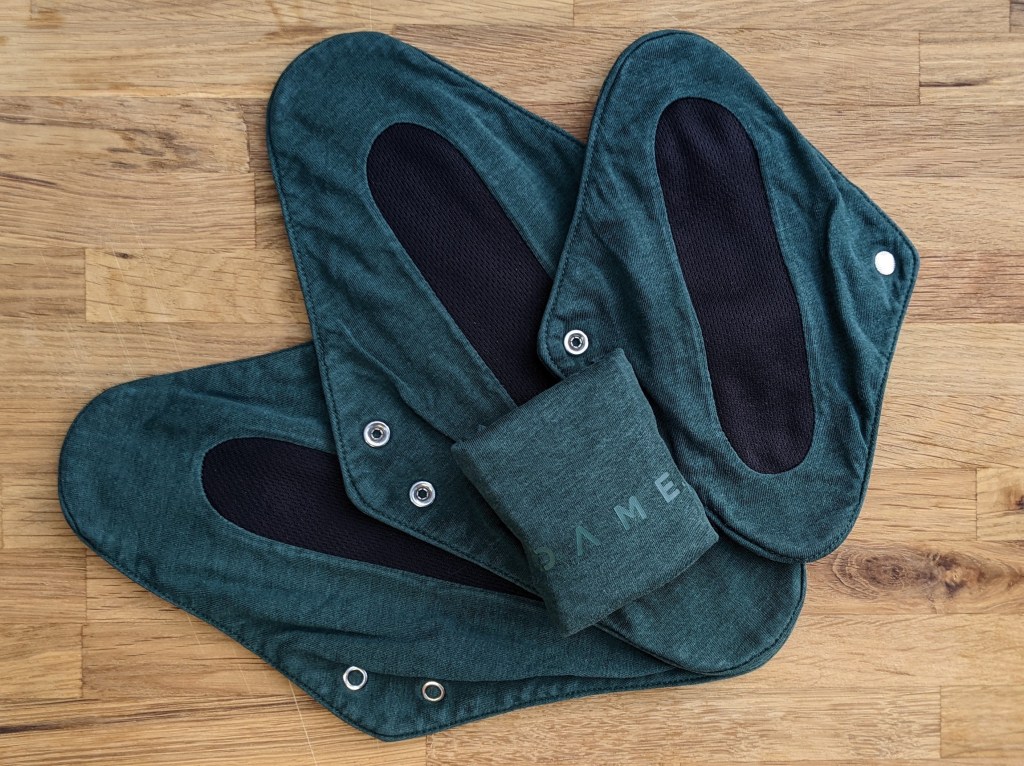
Once I’d decided that I was sold on the idea of reusable period products, I wanted to look into getting more pads, and started some research into the more expensive options on the market as I’m very much of the opinion that investing a bit more money can lead to a product with a longer life. I stumbled upon DAME. Now DAME very much comes across as a premium sustainable product shop and their products have a price tag to reflect this. Having committed wholeheartedly to going plastic free for my periods, I wanted to treat myself to something that I considered a bit fancier. And they were – the product was very well made, with metal poppers, defined shapes that indicated where the inner lining was, they were lovely to see and handle. However, this doesn’t mean that I prefer them over the eco bravo pads. While I still use both sets on a monthly basis, I actually prefer the low cost set and use those more frequently. This is purely due to the fact that I have a heavy flow and the DAME pads couldn’t quite keep up without changing at a pace that has left me in a tricky spot before.
Now, the big question. Do these pads hold up in my opinion? Would I recommend that people make the transition? While I do believe that reusable period pads are the way to go, I wanted to outline the challenges and benefits that I’ve come across and leave the final decisions to you.
| Challenges | Benefits |
| The need to carry used pads with you until you return home and are able to wash them. You need to plan your washing schedules ahead of time to make sure that you have a regular and consistent supply of clean pads. Still requires quite regular changing, especially with heavy flows. Some brands can be slightly bulkier to wear than disposable pads. | A wet-bag is a great solution provided by most reusable pad companies to help you carry used pads safely and securely. They are much more comfortable than previous plastic pads I’ve used. They give me great peace of mind. There aren’t any adhesive ‘wings’ to get stuck to my skin and cause rashes and discomfort, especially for those of us with sensitive skin. No plastic waste. |
Personally, for me, the benefits outweigh the challenges. Is it the same for you?
Now, I’ve raised one point in particular about planning washing schedules. I recognise that some people might be concerned about the additional cost of energy and water for washing a reusable period product, or have a concern about washing used pads with other clothes, but there’s no reason not to wash pads with other clothes in a dark wash. I’ve done this many times to try and save water and energy and I’ve not yet found any disadvantages to this. I feel very strongly that many of us believe that we shouldn’t contaminate clothes with period blood because its ‘gross’, but this comes from a culture of shaming people who bleed into not talking about these things with others. It’s a natural process and, just like washing can get a grease stain out of jeans, the same wash can get period blood out of your reusable pad. It’s important to remember that we can’t depend on a convenient world anymore if we want to make a change and with this, we need to readjust some of our comfort zones too.
With the challenges and benefits on the table for everyone to see, I think it’s also necessary to take a look at the environmental impact and possible economic impact I’ve made by choosing reusable products over disposable.
In order to understand the cost savings I might have made. I started using reusable pads in November 2021 so I wanted to see my impact in the last two years. I started off by getting an average cost for one pack of 14 disposable pads that I used to use from five different shops. Lets break this all down:
- Average cost for 14 disposable period pads = £1.63
- Price per individual pad = £0.12
- I would roughly get through 18 pads in a monthly cycle, so price per monthly period cycle = £2.16
- In a year, I would spend £25.92 on disposable period products
- I’ve had roughly 16 years of menstruating so far, so in my life so far I’ve spent £414.72 on disposable pads.
Seeing it laid out like this is an eye opener, for sure. But, to date, how much have I spent on reusable pads and is it a cost saving?
- In the first 12 months I used the set from eco bravo which cost £21.95 for a set of 6.
- Price per pad = £3.65
If, in a year, I spent £25.92 on disposable products, then I’ve saved £3.97 (£25.92-£21.95) in the first 12 months of reusable pads. In the second year, I spent more money on a more expensive brand, so lets look at that breakdown too:
- For a set of 8 DAME period pads, I spent £68.89
- Price per pad varied due to the size, but a rough average = £8.61
So, in the second year, if we use the same value of £25.92 on disposable products from before, I actually spent more than I would have spent on disposable items:
- £25.92-(£68.89+£21.95)=£-64.92.
Ouch. So I actually spent £64.92 more in the second year to use reusable pads. That’s a bit dejecting. I know that environmentally friendly products can be more costly due to the sustainable and ethical standards that the companies have to hold themselves to, but it’s still a bit of a shock. How will this look over the rest of my menstruating life though? If we take the yearly value of £25.92 for disposable products again:
- If I assume I will stop having periods at age 55, that’s another 25 years from now
- Based on the value £25.92, if I was to use disposable products (without factoring in inflation), I would spend another £648.00
- If I continue to only use the reusable pads I currently own, which all together cost £90.84, over the next 25 years, I would save £557.16
Okay, that makes me feel a little better. But this isn’t meant to be all about costs.
When we turn our eyes to the environmental impact of making this one change from disposable to reusable pads, the benefit is so much easier to understand. I mentioned earlier that I would use about 18 disposable period pads during a cycle. That means 18 pieces of plastic waste ended up in the landfill each month. Over the span of a year, I personally contributed 216 individual pieces of plastic menstrual waste and, over those 16 years, before transitioning to reusable pads I would have blindly sent 3,456 disposable pads to landfill. Let me remind you that these things do not break down – they’re not meant to! I knew I had been a contributor to this issue, but actually seeing that number is honestly a horrible feeling. I’ve been doing the maths as I’ve been writing and my heart hurts. I have to remind myself that these are past actions that I can’t change and that what I’m doing now is making a difference. To turn these hard-hitting figures on their heads, since changing to reusable pads, I have prevented 18 disposable pads from ending up in landfill each month for the last two years, therefore I have actively prevented 432 non-degradable, plastic pads from damaging the environment. And I don’t plan on going back, so looking ahead to the future impact, I will be preventing approximately 5,400 single use, disposable, plastic pads from being thrown away.
These numbers are all based on just me. This is just one person’s impact on the environment just by changing from plastic pads to reusable cloth pads. Imagine how large those numbers will get if 5, 10 or even 50 people make the same change.
Something that can’t be ignored in this conversation is that fact that some people might not be able to make this transition. I’ve outlined the positive impact a change like this can make, but there are many people out there who, for one reason or another, don’t feel comfortable, or simply cannot use anything other than disposable products. I think we can all do more to discuss the real impact we can all have on these things and influence our friends and loved ones towards more sustainable practices, but we shouldn’t push or villainise others for not being ready or able to make these kinds of changes.
Now, I’ve talked a lot here about period pads specifically and that’s because tampons have never appealed to me. The type of period product you choose is an incredibly personal choice and while I can’t currently offer an opinion on these there is a sustainable market out there for other period products, including tampons, period cups and period pants, some of which I might try out in the future.
Remember, it’s important to do your own research. There’s so much out there and I strongly believe that there will be a sustainable choice to meet your personal morals and budget.
 The Glass Jar
Leave a comment